Sponsored article
Why Do Some Bar Trays Maintain Their Grip While Others Lose It?
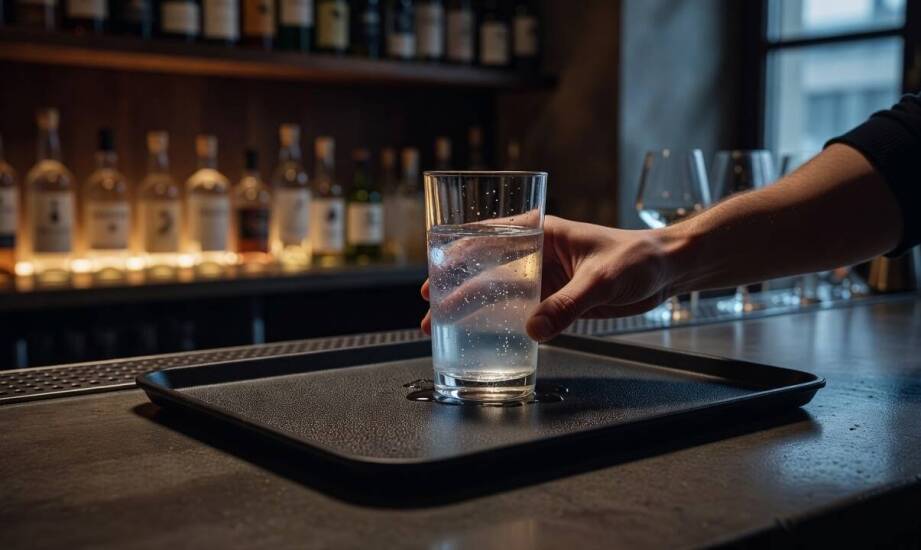
A good non-slip bar tray needs to keep glasses stable throughout regular hospitality use. Whether it continues to provide sufficient grip depends on more than the initial texture of its surface.
The material system, design of the working surface, method of manufacture and cleaning conditions all influence how the tray performs over time.
Understanding these factors helps explain why two trays that appear similar when new may behave very differently after repeated use.
How Does Surface Design Affect Grip?
Grip is created by increasing friction between the base of the glass and the surface of the tray.
Manufacturers can achieve this in different ways. One solution is a specially designed surface structure formed as part of the rigid tray itself. Another is the addition of a dedicated anti-slip layer made from a material with different friction properties.
The effectiveness of either approach depends on the complete design.
A surface that is too smooth may provide insufficient grip when wet, while an excessively deep texture can make cleaning more difficult.
The objective is therefore to create enough friction to reduce unwanted movement without producing a surface that traps dirt or becomes impractical to maintain.
Which Materials Are Used for Non-Slip Bar Trays?
Material selection has a direct impact on both structural stiffness and surface grip.
Noex manufactures non-slip trays using combinations such as polystyrene with PU or TPE anti-slip surfaces.
The rigid part of the tray provides shape and structural support, while the softer surface material is intended to improve grip.
PU and TPE should not be treated as identical materials.
Polyurethane and thermoplastic elastomers have different formulations and performance characteristics, so their suitability depends on the design of the specific tray and its intended operating conditions.
A softer anti-slip layer can provide better contact with the base of a glass than a rigid plastic surface, particularly when moisture is present.
However, grip also depends on contamination, wear and correct cleaning.
Why Does Tray Design Matter?
The effectiveness of the working surface cannot be separated from the overall geometry of the tray.
A professional tray also needs sufficient rigidity to prevent excessive bending under load. Its rim, base and wall thickness should work together so that the carrying surface remains stable when several glasses are transported.
Injection mould design therefore needs to take into account:
material shrinkage;
wall thickness;
reinforcing features;
surface geometry;
dimensional stability.
The surface design must also be manufacturable without making the finished part unnecessarily difficult to release from the mould.
Noex combines injection moulding with its own tooling facilities, allowing product geometry and the production process to be developed together.
Why Can a Non-Slip Surface Lose Performance?
A reduction in grip does not necessarily mean that the material itself has failed.
The surface can also become less effective because of:
grease or drink residues;
incorrect cleaning products;
abrasive scrubbing;
mechanical damage;
exposure to unsuitable temperatures;
normal surface wear.
A soft anti-slip layer has different care requirements from a standard rigid plastic tray.
For this reason, cleaning recommendations should always be treated as part of the product specification.
Using aggressive chemicals or temperatures outside the permitted range can alter the surface and shorten its useful life.
How Should Non-Slip Trays Be Cleaned?
There is no single cleaning method suitable for every bar tray.
The correct procedure depends on the material and construction of the selected model.
For Noex trays with an anti-slip surface, current product instructions specify cleaning with water at a temperature of no more than 35°C, without detergents or other chemical substances.
The surface should not be scrubbed and should be cleaned using soft materials such as a cloth or sponge.
These recommendations are important because intensive cleaning is not automatically beneficial.
A method that removes dirt effectively but damages the working surface can gradually reduce the tray's functional performance.
What Should Be Checked During Quality Control?
Quality control should confirm that the finished tray meets the requirements established for its intended use.
Relevant checks can include:
dimensions and flatness;
surface appearance;
adhesion and integrity of the anti-slip layer;
rigidity under the expected load;
visual defects;
repeatability between production batches.
Noex states that it tests raw materials, manufacturing components and finished products as part of its production activities.
For a non-slip tray, the final assessment should focus on the complete product rather than judging the rigid polymer or surface layer separately.
Does Recycled Material Affect Anti-Slip Performance?
Recycled plastics can be used in serving products where their properties meet the technical requirements of the design.
However, recycled content alone does not determine how well a tray grips glassware.
Anti-slip performance depends primarily on the working surface, tray construction and interaction between the selected materials.
If recycled content is introduced into the rigid structural part, its processing behaviour and mechanical properties still need to remain sufficiently consistent for series production.
Where several materials are combined in one tray, end-of-life recycling should also be assessed for the complete construction rather than assuming that every multi-material product will follow the same recycling route.
What Makes a Non-Slip Tray Durable?
Long-term performance depends on several elements working together:
an appropriate structural material;
a stable tray geometry;
an effective anti-slip surface;
controlled manufacturing;
correct cleaning and maintenance.
Neither a rough texture nor a soft elastomer layer automatically guarantees permanent grip.
A non-slip tray maintains its functionality when its materials, construction and care requirements are matched to the conditions in which it is actually used.
For hospitality businesses, following the manufacturer's cleaning instructions is therefore just as important as choosing the right surface technology in the first place.
You might be interested

The uniqueness of handmade ceramic bowls – what sets them apart?
Why are deburring tools essential in stainless-steel processing?

The process of creating stoles for clergy: from design to final product
